
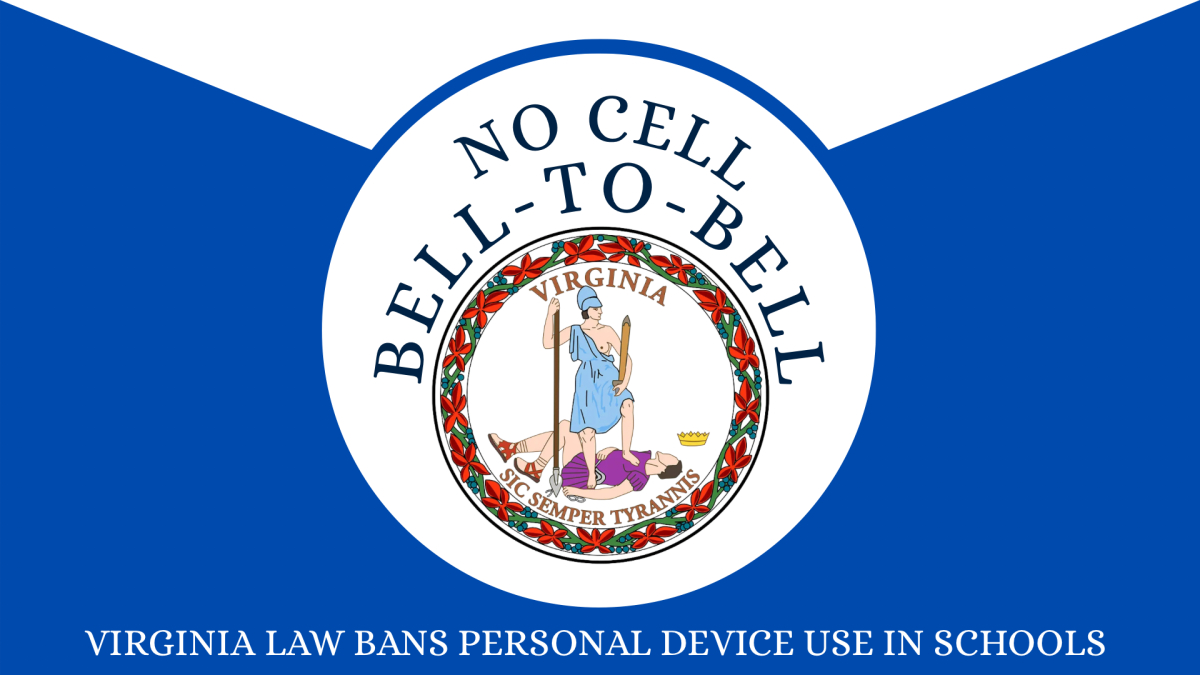











On July 9th, 2024, former governor of Virginia Glenn Youngkin issued Executive Order 33 to “bring cell phone-free education to Virginia schools”, also known as the “Bell-to-Bell” law. The law rules that students are not allowed to access their personal devices from the morning bell to the dismissal bell “recognizing the mental health effects on children and the impact student’s dependence on cell phones are having on schools,” as said on the Virginia Department of Education website. The Virginia Department of Education gave school divisions the responsibility to “determine if revisions to existing cell phone and personal electronic communication device policies are needed.”
When the 2024-2025 school year started, students at Park View adapted to a new LCPS policy, Policy 8655, approved by the Loudoun County School Board on June 25, 2024 before Executive Order 33 was issued. The policy restricted personal device use during instructional periods.
But on December 16, 2025, the LCPS school board updated Policy 8655 to be in correspondence to the law passed in July 2024. Staff of LCPS were informed of this update on December 17, 2025.
When Park View’s staff came back from winter break on January 5th, 2026, they had to adjust to enforcing the new policy, including in between classes, lunch, and study hall, not just during instructional periods. Since the start of this policy, more and more students and staff are speaking out on their various opinions about it.
Some students have found that the law has been beneficial to them in class.
“I think it’s an adjustment but greatly benefits the students’ education and helps us to be more engaged during the school day,” said one Potomac Falls student who responded to an anonymous survey sent to LCPS journalism students.
Some students believe that academics will be more fair without phone usage.
“People are cheating a lot, and I don’t think it’s fair to those who actually do try,” said Nicole Ortuno, a junior at Park View.
Other students from Potomac Falls High School also shared that they believe schools shouldn’t be a place where students are constantly being told what to do.
“We don’t need our devices being policed like this because it just provides a higher incentive to wanna break the rule,” one student from Potomac Falls said.
Another student expressed that it’s unfair to those who don’t take advantage of their phones at school.
“If a high school student is using his or her phone when he or she shouldn’t be and is behind as a result of that misuse, that is entirely on them and is not something the collective majority should be punished for,” one student from Potomac Falls said.
Students have also noticed the unfairness in staff using their phones when they should be leading by example.
“[Staff] is telling us to put our phones away but not following the school rules themselves [sets a bad example],” said Heylin Hernandez Peña, a junior at Park View.
Some teachers have expressed their concerns on students’ dependence on their phones having a negative effect on their future.
“I’m a firm believer in the fact that students today have struggled with cognitive learning and [even learning from] computers has changed how kids can articulate or talk to people,” said Nicholas Bailey, a Government and Economics/Personal Finance teacher, and SCA co-sponsor at Park View.
Other teachers also think that the enforcement of the LCPS Policy can have a positive impact on students’ current lives.
“I think once [students] realize that there is a life outside their phone [and they should be] focusing on [their classes…] more people will live life outside of phones,” said Tom Wellington, a history teacher at Park View.
Some teachers at Park View have also shared that the enforcement of the policy has been left up to them.
But according to the Guidance for Cell Phone-Free Education Pursuant to Executive Order 33, “School leaders must put in practices and procedures that allow teachers to focus on classroom instruction and not manage cell phone usage class to class.”
Some teachers have found that Policy 8655 has been ineffective at getting students off their phones due to limited state guidance.
“There’s not a lot of consequences put out and because there’s no consequences it doesn’t force people to have to actually [abide by it],” said Bailey. “I think that the state needs to put more rules and punishments to [share] what they expect.”
But compared to Loudoun County’s phone policy, Fairfax County Public Schools SR&R supplies a discipline matrix for students which provides up to four violations resulting in consequences. These consequences consist of confiscation, detention, and loss of privilege where students turn in their phones at the beginning of the day and pick it up after the dismissal bell. LCPS does not provide a rubric for teachers and admin to abide by for students that violate the policy.
“I haven’t seen anything from anyone, like they don’t care at all,” said Ortuno.
A big concern many students have expressed across the county is the inability to contact their families in case of an emergency.
“In situations where there could possibly [be a] lockdown or a student doesn’t feel well, it’s not good to have the phone policy because [students] won’t have the ability to reach out to their parents,” said Hernandez Peña.
In the Guidance for Cell Phone-Free Education Pursuant to Executive Order 33 document, Virginia has left it up to school divisions to create protocols on cell phone access during school-based emergencies. The FAQS on the LCPS website, which shows many concerns parents have shared, says parents may contact the school’s main office in case of an emergency. But the LCPS SR&R Handbook states that “Staff and students are discouraged from using cell phone communication because it ties up critical bandwidth needed for emergency responders.”
This has left students confused and concerned should an emergency arise. One student at Park View shared an example of how she utilized her phone to ensure the safety of her loved ones on March 16, 2026, when Sterling, VA underwent a tornado warning.
“As soon as the tornado hit I was extremely worried since [my parents] often work outside and are not always aware of the weather. After calling over 10 times, I finally got a hold of my mom, and without me calling her she would’ve been outside during the storm,” said Keylin Marroquin Garcia, a junior at Park View.
School divisions have also been instructed to “communicate [emergency protocols] clearly to parents and students.” But students have shared that they haven’t heard any instruction from school leaders on phone usage during emergencies after the passing of the phone law.
“This new phone policy is so new and people aren’t used to it, so I feel like not getting information or updates about it [can confuse students and families] because information isn’t being spread,” said Hernandez Peña.
One of the main obstacles Virginia hopes to overcome with this law is the negative effect cellphones have had on adolescents. The Virginia Department of Education states the studies have shown that “boys and girls experienced a spike in depression of 161% to 145%.” But research isn’t the only source that shows the change in teens, “It’s the real life experience that parents, teachers, family members, and even children themselves recognize in young people’s behaviors.” says The Virginia Department of Education.
“In middle school I saw a lot of people start downloading social media apps and it affected their view on themselves and others.” said Valentina Brown, a junior at Park View.
But some students find that cell phone time can be essential to staying attentive in school.
“I don’t think adults realize how exhausting [going to school for hours] actually is. Social media, texting our friends or parents, and playing games helps us unwind. Adults need to understand [that students] using social media isn’t a crime, it’s supposed to help us unwind,” said one Loudoun Valley student who responded to the survey
The Guidance for Cell Phone-Free Education Pursuant to Executive Order 33 document states another reason for this law was to promote “a healthier and more focused educational environment.” But something the state of Virginia didn’t consider was the classes that would be negatively affected from the prohibition of phones.
“Our devices are a part of our lives [and] there are careers and valuable job skills that can be learned using our devices, and I think my journalism classes are a great example of that,” said Mr. Andress, an English and Journalism teacher at Park View.
Before the ban, journalism students used their phones to create content either for interviews or for broadcasting content. But when Policy 8655 was first updated, students’ projects were slowed down because many schools hadn’t been provided with sufficient equipment.
“It takes so much longer to film a simple 1 minute video since more than 20 students rotate between 2 cameras,” said one student at Potomac Falls.
In March, LCPS provided all Journalism classes in Loudoun County with $5,000 worth of camera equipment. But before this, journalism teachers hoped that Virginia would simply adapt the law to accommodate for their classes.
“There needs to be room for exceptions in our case because it’s a legitimate and valuable tool in my classroom,” said Andress.
A lot of journalism students use the skills they learn in journalism classes to make money for themselves outside of school or make it a career for themselves in the future, displaying how journalism classes have prospered even with the use of phones.
“I’ve started a small business. Because of the classes, I got an internship at Viva Loudoun and found a passion that I find therapeutic,” said Allison Canchanya Bujaico, a senior at Park View.
Alongside journalism classes, the Park View SCA was affected since they utilized their phones at school to create social media content promoting school events and creating campaigns.
“We were thinking how are we going to [make] videos, how are we going to promote the school,” said Chellsie Candia-Villacorta, a junior at Park View and a member of the SCA Media Committee.
Another student also commented on how productivity for the media committee has been hindered.
“Honestly, it was hard to think about how I was going to keep growing the Park View social media pages. I’d been doing a good job of that, and then the phone policy started,” said Tiffany Turcios Cruz, a senior at Park View and Media Director for the SCA. “Journalism, SCA, and Art classes should have exceptions. It can be a space for inspiration.”
***
Additional research: Genesis Marquez Portillo